Method Overview
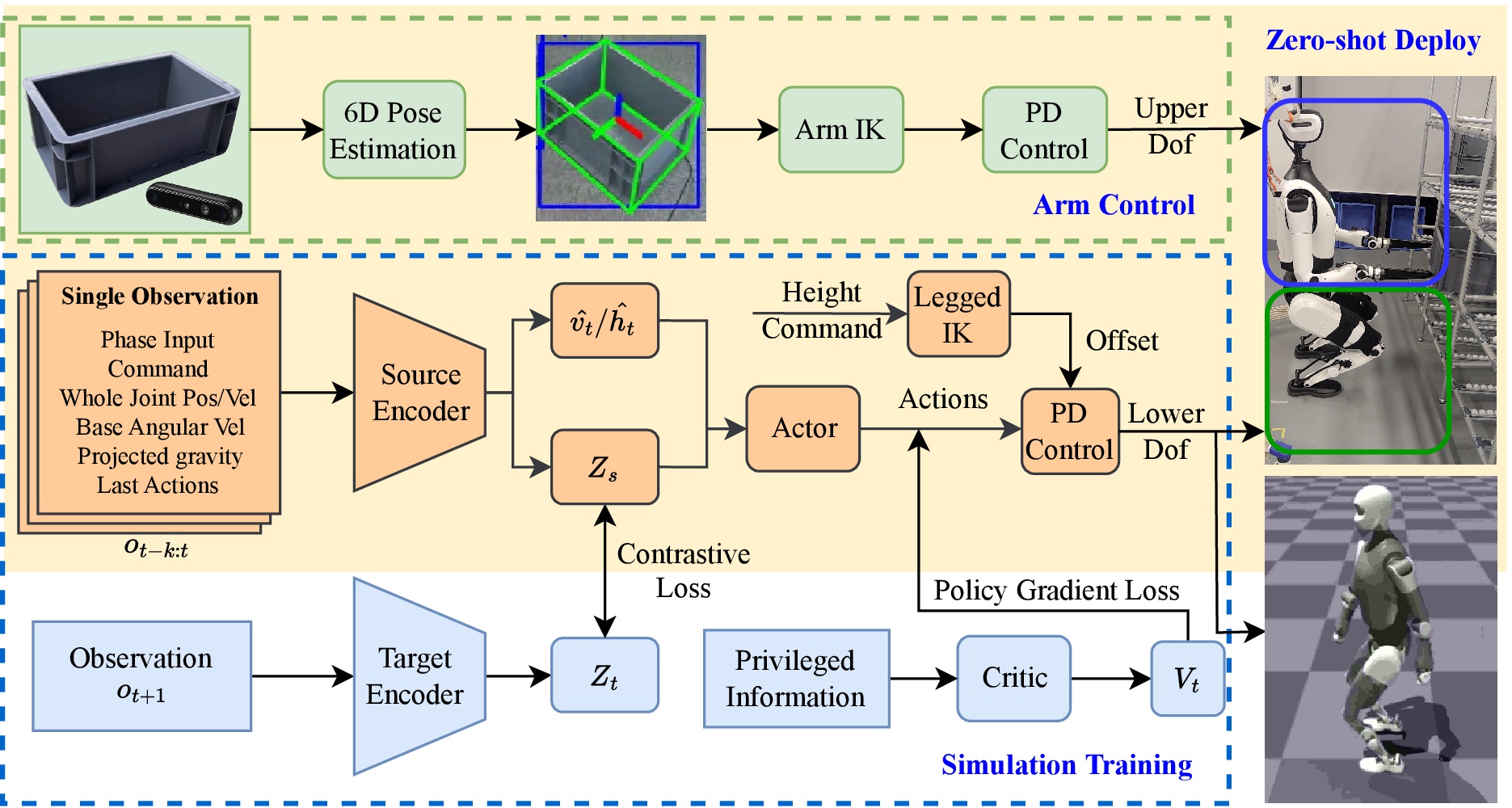
Humanoid robots performing industrial transportation must maintain stable locomotion while coordinating perception and manipulation under varying payloads. This paper presents a payload-robust locomotion framework for full-size humanoid robots. The commanded base height is analytically mapped to a nominal lower-body configuration. A kinematics-based locomotion reference is used only to guide policy training. Upper-body motions and end-effector payloads are randomized during training, while deployment motions are generated by a perception-driven kinematic controller. A temporal history encoder estimates base velocity and height and extracts a latent feature from recent whole-body proprioceptive observations. The lower-body policy is trained entirely in simulation and transferred to the physical robot without fine-tuning. Simulation results demonstrate faster convergence, accurate base-state estimation, and latent structure associated with payload variations. Real-robot experiments validate stable box transportation under varying payloads.